Cardio at Midnight

Cardio at Midnight

Just a little something that dripped from my pen before doing Wordle at 12:01 AM.

The mental prompt for this, a phrase that sprang to mind shortly after succumbing to the need for sleep: “a country that has lost its minds and hearts.”

Cardio at Midnight

Sweat-soaked, shaking
from a half-remembered dream:
a frantic quest for keys
clutched in a bloody fist,
for glasses worn atop
a severed head, and for
a barely beating heart,
devoid of hope
but full of dread.

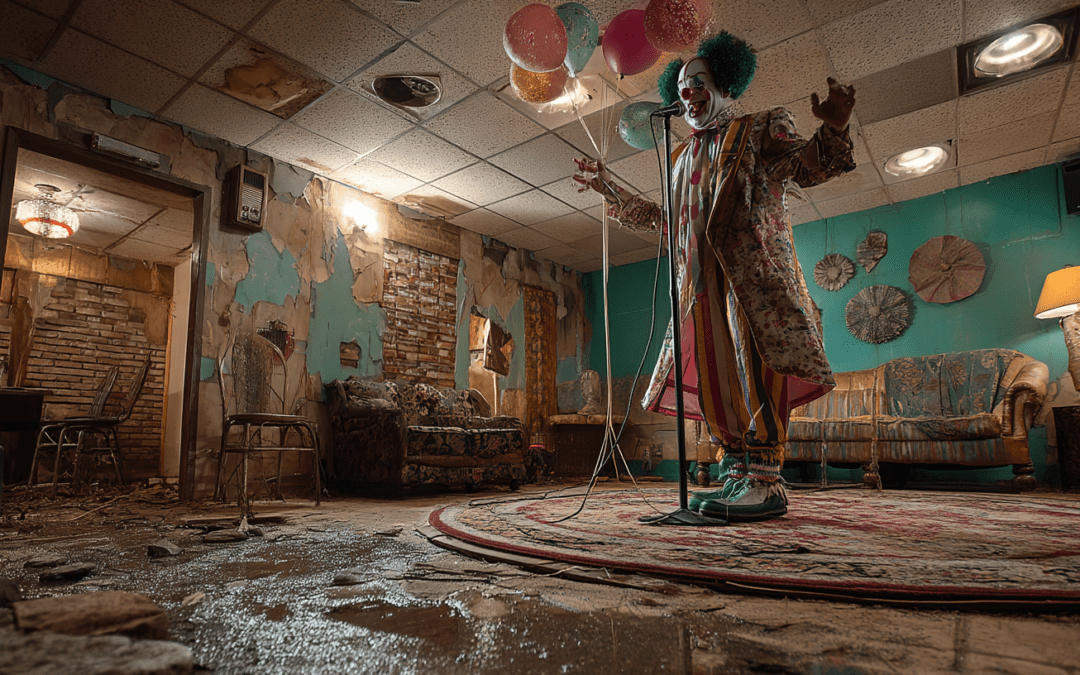
They say, “Sleep on it,” but sometimes it’s good not to do that. Did I have nightmares last night? No. Will you, now?

Beauty Killed the Beast

Beauty Killed the Beast

I had every intention of titling this month’s poems in alphabetical order, but best laid plans, eh? I started off thinking about “beauty.” Good “B” word, right? And then one of my grandfather’s aphorisms sprang to mind: “Pretty is as pretty does.” This poem sprang from that and a conversation about the hypocrisy of certain “good Christians” and politicians and how there’s a psychological term for their particular, self-loathing brand of judgmental hypocrisy. “Pretty” isn’t it. Nor is “beauty.” But with any luck, you’ll follow the mental processes to see how we got here from there.

Reaction Formation (an Acrostic)

Righteous in hypocrisy, they think to
exculpate themselves, 
accusing others of their flaws, defining
crimes where none exist
trying to deflect self-loathing
images held dear, judging, demonizing
others in their zeal, their quest: to
nullify the hatred turned within.
​
Fathers, mothers - stand
outside the need to make a tiny
replica, to form of nascent clay a 
man or woman in your image. Only God’s
allowed that power —
that perfection you’ve dared judge 
immoral, turned a well-honed weapon
on itself. Devoid of love, the world can
never make itself anew.
April is a Foolish Month

April is a Foolish Month

April is, of course, National Poetry Month. And April 1st is the beginning of the A to Z Blogging Challenge, which I completed with a poem a day – in the spirit of NaPoWriMo / GloPoWriMo – in 2023. The Writers Digest Poem-a-Day (PAD) Challenge, which I did last November, begins anew today. And of course I’m in my second year of doing The Stafford Challenge, which is to write a poem a day for a  whole year. Today is Day 75. This year? I’m doing them all. Plus entering 30 poetry contests, judging two, enjoying fun time with family, traveling to the last two of fifty states I haven’t yet visited, and attending Poetry at Roundtop. Yay!

Today’s poem was…

Originally titled, “Art Class.” After sharing it among a small group of poets who suggested a better title, I’m calling it “Origami Wings.”

I hate that writing, once it has “lost its virginity” by being published in any form, is devalued – never mind that there are, perhaps, 30 readers who will ever see it here on this blog. In 2023, Timothy Green proposed a new term of art that has gained some traction among publishers: “Uncurated.”

Imagine how literature would thrive if we could share our art with our friends in the medium of the era. How much more fun would online open mics be if everyone knew they were free to share the poem they were most proud of—the one they just wrote yesterday? Rattle’s weekly podcast includes a supportive and enriching open lines segment, but most poets are hesitant to share and “spoil” their newest work. The joy of sharing what we create is one of the main things that sustains us as artists. We shouldn’t have to wait years wading through rejection letters to feel it.

Read Green’s whole proposal at “Uncurated: The Case for a New Term of Art.” Unfortunately, this won’t work well for contests where anonymity is important to fairness. I was going to hold back, but a small voice in my head reminded me that words are meant to be read. Ideas are meant to be shared. Communication is an act requiring two or more.

Today’s Poem is…

Origami Wings

She made the most
exquisite corpse
folded over on itself
half a dozen times. The best
of times when flowers
graced her curves,
her ample breasts; the worst
of times, when they
cast cross-hatch shade
concentric circles,
levers, steampunk gears
between her hip-bones, thighs,
as if to mar her
nakedness and make of her
a twisted mess of cobbled parts
laid bare beneath
florescent glare for little
boys to snicker at,
while girls decided then
and there to bind
their chests, lean in
to art and ugliness,
express revulsion, silent
rage - while bleeding
ink through every knife-edged
paper crease, until
one artist's fingers
deft with mercy
turned her corpse to origami
folded arms to angels
wings and
   let
     her
       fly
Serendipitous Moments, Crazy “Challenges”

Serendipitous Moments, Crazy “Challenges”

It’s a Small World

About a week ago, a girl’s name popped into my head along with the impression that we’d been friends when we were little. Our moms must have been friends and I vaguely remembered something about eating lunch with her, possibly Spaghetti-Os. At least that was the visual snapshot – I can almost picture the table.

I had no idea how to spell her name. Fortunately, it’s not “Smith.” But who knows – women our age often changed our last names when we married, so the odds weren’t really in my favor. I did a Google search, anyway.

I found someone on Facebook who’d posted about a childhood memory of Kent State University that was uncannily similar to mine. I sent her a message and asked if she’d gone to the same Kindergarten I had gone to and did she remember the teacher.

She had! And she did. And after comparing what were, for both of us, vague and hazy snippets of memory, we were certain we were in the same class. We may even have taken ballet lessons elsewhere from the same instructor. Neither of us was any good at it and we both hated it.

But here’s the even funnier part: I told my daughter about this and mentioned where the woman worked. She replied with laughter and “you’re kidding?!” Turns out my friend is the Executive Director of a legal services non-profit that my daughter did a project for while she was working on her Masters degree. She is now more than halfway through law school, herself. But she and my friend had never met. Now they’re connected on LinkedIn.

I love odd, serendipitous moments like this.

Not in Kansas Anymore

But I was! After talking my husband into taking me to Santa Fe, Taos, and Los Alamos, New Mexico (one of two states, along with Kansas, that he had been to but I had not), I called up a friend in Lawrence, Kansas, and asked if she might have time to hang out with me for a day or two this month. Honestly – and no offense to what I’m sure is a beautiful state – visiting her was absolutely the only reason I could think of to go to Kansas. Now, Polli isn’t just any friend. I’ve known her for close to thirty years. Except that we’d never met face-to-face before. As for how we became friends in the first place, I think the post Gratitude and a List explains it best. I had a marvelous time exploring Lawrence, Kansas, seeing where my friend works, enjoying good food and good company. It was a short visit, but well worth the trip!

A(nother) Challenge, or Am I Just a Glutton for Punishment?

April is, of course, National Poetry Month. And April 1st is the beginning of the A to Z Blogging Challenge, which I completed with a poem a day – in the spirit of NaPoWriMo / GloPoWriMoin 2023. The Writers Digest Poem-a-Day (PAD) Challenge. And of course I’m in my second year of doing The Stafford Challenge, which is to write a poem a day for a  whole year. Today is Day 65. This year? I’m doing them all. Plus entering 30 poetry contests, judging two, enjoying fun time with family, traveling to the last two of fifty states I haven’t yet visited, and attending Poetry at Roundtop. Yay!

National Poetry Month Official Poster

Upcoming

I have a poem published in Amazon.com: I Am From: Anthology of Essays, Poetry and Prose eBook : Brearley, Susan, Arvizu, Nanci, Barrett, Rebecca, Lemay, Melissa, Tomey-Zonneveld, Lisa, Nickerson, Shannon: Kindle Store

Necia Campbell – fellow mischief-maker – and I have a collaborative poem, “When the Last Cricket Sings,” that will be published by Collaborature on April 2, 2025. I have a URL, but WordPress will just gripe about it being a broken link until the poem is published, so I’ll wait and update this post later. If I remember.

Your Turn…

Leave me a comment: Tell me about your serendipitous moments, crazy projects and challenges, and good news!

April is a Foolish Month

Artist Date, Ekphrastic Poetry, and AI as Impartial Critic

Each month, Poets Northwest meets in NW Houston to share poems and tips on writing poetry. Next month we’ll be focusing on revision, as well. This month, we were challenged to write an ekphrastic poem about a local artist or work of art displayed locally. It was there that I learned from friend and fellow member, Lynn G., about the Pearl Fincher Museum of Fine Arts – located about 15 minutes from me. I must live under a rock. I’ve been to the courthouse and I’ve been to the Barbara Bush Library, both of which are walking distance from the Pearl.

I called Lynn on Thursday to tell her I was going there to “do my homework.” I was already four blocks from my house when I asked her, “Wanna come?”

To my surprised delight, she said “Why not?” and pulled into the parking lot about 10 seconds after I got there.

“An artist date!” I think we both mentally pulled out our old copies of The Artist’s Way, by Julia Cameron.

Below, you’ll find my “homework,” an ekphrastic poem based on a work of art by Caroline Z. Marcos entitled, “Ocean Biome.” Several works of art inspired me, but this one tempted me to explore the images more deeply.

Nick Thacker, whom I met at last year’s Oklahoma Writers Federation Inc. (OWFI) Annual Conference, presented a session called “Write 80,000 Words in a Day.” I’ll admit that while I am not one of the rabid AI haters, I rolled my eyes at him and whispered, as he tried to convince me to stay, that the only way to produce that much output was with AI. I have too much professional pride to let AI write for me. And any AI images I use? I don’t ask friends to do free labor for me and I won’t pay for blog header images. I don’t trust “found on internet” freebies. And my own photos don’t always “go” with what I’m writing. But for anything involving a profit, like illustrations for a children’s book? You bet I’d pay a real artist.

That was probably a bad example, as I have yet to make a real profit from my children’s books, but you know what I mean – I hope.

“AI, but not what you think,” Nick said. “Stick around. You may be pleasantly surprised.” I did, and I was. He wasn’t suggesting the use of generative AI to write those 80,000 words after all. And (not) being from Missouri, but being somewhat skeptical, I tested his suggestions out right there during his session. He uses dictation – something I’m still too self-conscious to do – to draft the novel, then uses AI, acting as a proofreader/copy-editor to clean up grammar, spelling, and punctuation. It’s brilliant. And yes, you still have to read it and fix a few errors – it’s far from perfect and still quite human-centered.

One of my favorite ways to use AI as a tool is to analyze, list strengths and weaknesses in my writing, and offer suggestions. I have never seen it suggest its own words, and wouldn’t use them if it did. AI writes doggerel, at best. It can recite the rules of formal verse, but rarely manages to follow them. It can invent new forms – which is a fun new pastime of mine – but you have to be careful and check its work to ensure that it hasn’t just renamed an existing form.

As a critic, though, it is competent. I use it, occasionally, to ensure that my metaphors and similes aren’t too much of a leap – figuring that if AI gets the message I’m trying to convey, a human reader should have no trouble understanding it. I use it to make sure that symbolism is neither too obscure nor too obvious and cliché, to catch little speed-bumps and unintended repetition. It does a pretty decent job. And it offers constructive criticism without nastiness or sugar-coating, often treading where humans fear to tread in a misguided belief that heaping nothing but unconditional praise on a writer’s head is helpful. Sometimes, that praise is an understandable fear, like traversing a minefield. See Delicate Sensibilities. For real poets, it’s more like… | by Holly Jahangiri | Medium

As with human critique, it’s important to know what rings true and what makes no sense in the context of the writer’s vision. Here’s an example of where I used AI through three revisions of the following ekphrastic poem: ChatGPT Poem Analysis, Strengths & Weaknesses.

Ekphrastic poem, "Ocean Biome," based on artwork of the same name by Caroline Z. Marcos. Within the mermaid's purse there lurks potential: a toothless, embryonic shark, half-formed, the harmless killer sleeps. Microscopic fragments, cork, float free of messages and empty bottles drift, aimless, lacking purpose. Kaleidoscopic mandalas bob deep, still glistening with surface-captured light, warmed by sun- irradiated clouds in fiery shades of tangerine. Lemon-slice reflections, burnished gold, a blazing comet-fish encapsulated in methane bubble - electric blue - streaks left, tail on fire. Translucent, stained-glass blossoms glow deep below the sapphire sea resolved to rise, returning to the barren land— Devoid of us. Indifferent. Invertebrates find growth, feed on peace among strange ornaments in a silent, alien ocean biome.

I think that ChatGPT is a little limited in its ability to “see” the artwork in question, though some image generators are able to analyze and describe an image. So the comments about the flowers and the “comet-fish” are not on point; I clarified the fish with its “tail on fire” but ignored ChatGPT’s suggestions about the flowers. Still, it was all just food for thought, and I agree with Cat Farts (my nickname for ChatGPT) that the last version is the strongest of the three, and I appreciate the feedback.