November, New Beginnings
Summer Hiatus
One of the things my husband and I dreamed of doing in retirement was to travel more. We finished visiting all of the states and started on National Parks. Between May and November, we have been to Utah to hike in Bryce Canyon and Zion National Parks; Calgary to explore Banff; Belgium for a family reunion with a side trip to The Netherlands; Pennsylvania – because my husband had never been to Pittsburgh or Philadelphia – I finally relented with the condition that we take a train around Horseshoe Curve and stop in Hershey for chocolate and for me to meet a cousin I’d never met face-to-face; Oregon to visit family and see Crater Lake and Deschutes National Forest; and the Dominican Republic to relax in Punta Cana and swim in a crystal clear lagoon at the tail end of hurricane season. That might have been slightly ill-timed, but we had fun and the weather was perfect. Until we left, and it wasn’t. We did get lashed (briefly) by some of Hurricane Melissa’s outer bands. I can only imagine, as one who lives in a hurricane-prone part of the Gulf of Mexico, the devastation in Jamaica, the Dominican Republic, Cuba, and the Bahamas. I would urge everyone to give what they can, despite challenging times, to aid in the day-to-day survival and recovery of the people in these islands. World Central Kitchen is an excellent place to start.
I didn’t write much poetry, despite (somewhat ironically) beginning my term as President of the Poetry Society of Texas on September 1. I thought that travel would inspire me to write, but what it inspired in me was mostly a desire to take long walks outside and to be lazy in between. Maybe that’s what’s meant by “recreation”: relaxation + time to reflect = creation.
From Utah, I sent poetry postcards to friends from one of my poetry writing groups.
Postcards from Utah
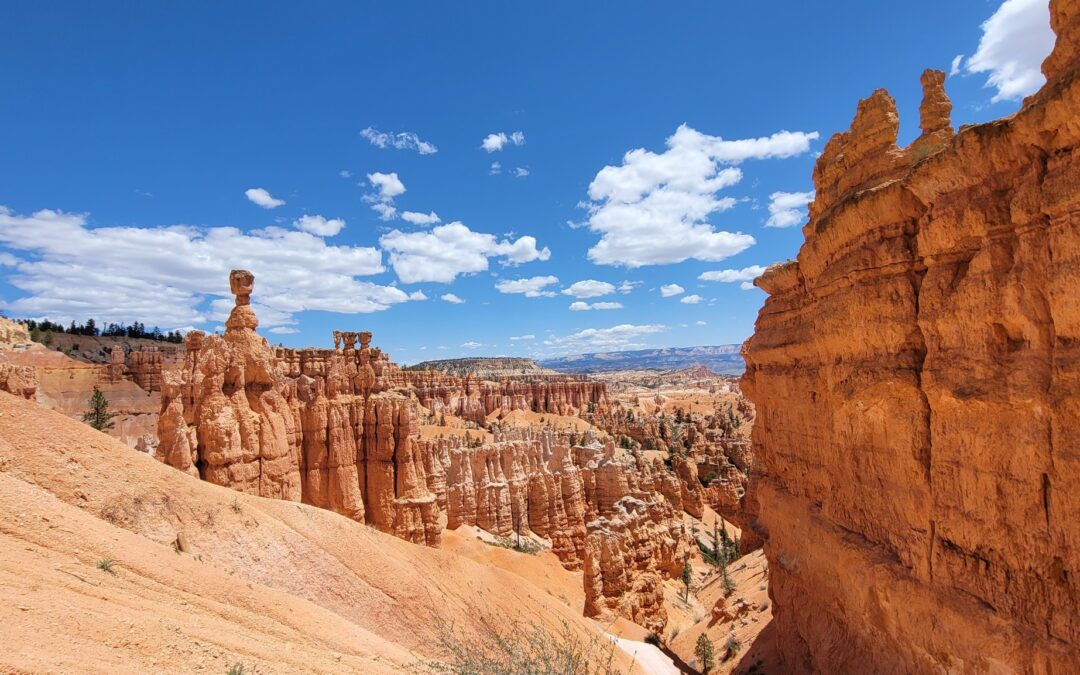
While in Utah, I learned my limitations. I don’t like limitations. But I learned that when the hiking map says “moderate” difficulty, it’s referring to elevation gain. And 600 feet down means 600 feet up, again, at some point. That’s the Sunrise to Sunset Loop at Bryce Canyon.
Never underestimate those trail ratings.
Eyeballs: “Easy-peasy. Look, it’s paved, even. Mostly. Sort of. Well, packed dirt and gravel.”
Me: “At least it’s not Cinder Cone.”
Trail rating: Moderate. Elevation gain: 600′.
Me: “That’s like, what, 6 stories?”
Brain: “You want me to math? On vacation? Fuck you. Try 60.”
Me: “And you’re waiting till I climbed DOWN already to tell me this? It’s 85° out here, and I have to climb the fucking Empire State Building – with no stairs?”
Brain: “Stop exaggerating. The Empire State Building is 1486 feet. This is half that. Get climbing. What goes down must come up. Remember: Cinder Cone was 813 feet and all gravel.”
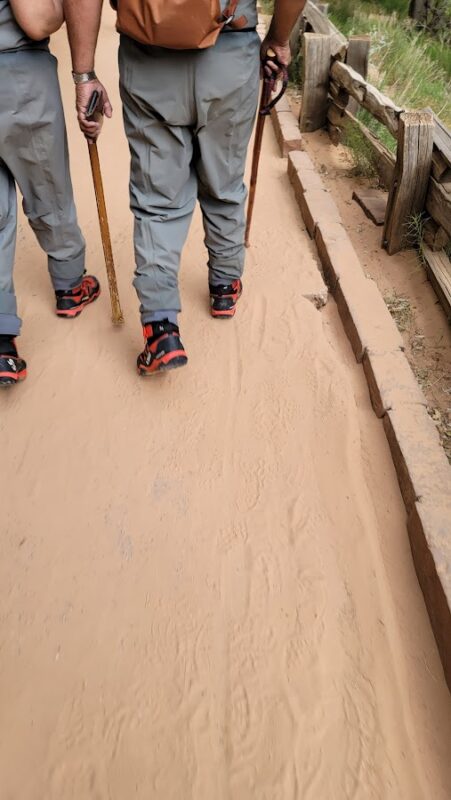
Me, taking this picture about 2/3 of the way up Navajo Loop: “JJ, when you find this picture on my camera roll, send it to the kids and tell them, ‘This is where your mother died.'”
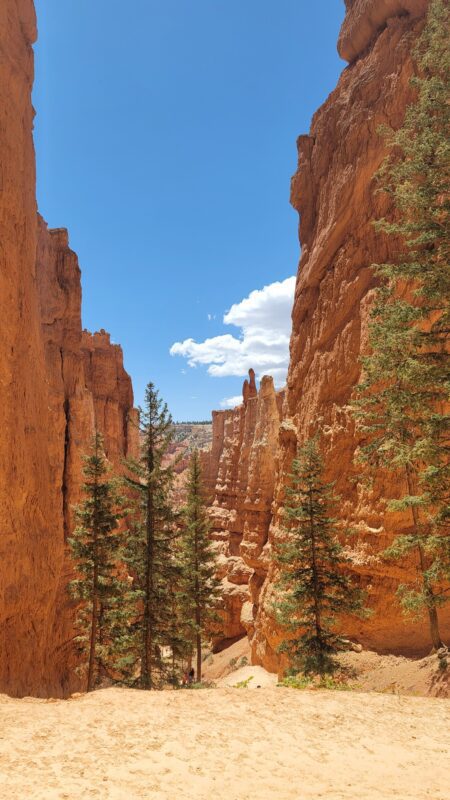
The empathetic laughter from other nearby hikers of all ages – also struggling – helped get me to the top.
At Zion, we stuck to the “easy” trails. I would have liked to hike The Narrows, especially after seeing children returning from the hike. Angel Falls? Oh, no, never. I won’t ever hike Half Dome at Yosemite, either. But The Narrows would be pleasant, I think, on a hot day.
Beechey Squirrel
Is it kindness to feed wildlife “snacks”? Or is it dangerous and selfish? I think most people mean well and merely want to establish a connection to those other beings we share the planet with. That connection might serve to tether us to nature, something too many of us hold ourselves separate and apart from. On the other hand, it fosters dependence in the animals who no longer have to work for their food, and carries a very real risk of spreading zoonotic disease to humans. That’s why there are signs warning of hefty fines – not to spoil the tourists’ fun, but to keep both animals and humans safe. Too many humans think they are the exception to the rule, or that “it can’t hurt, just this once.” All it takes is this once.
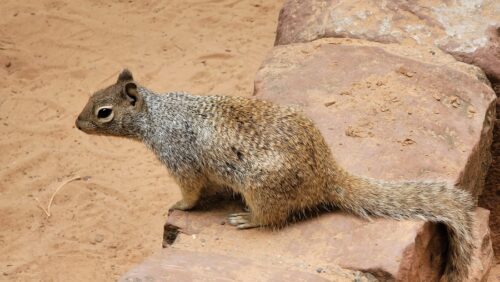
Spotted ground squirrel
unafraid of hikers,
playful siblings
squabble, tumble as one
bushy-tailed dustball.
A sign warns against
feeding plague rats.
The sign, the fine, mean
nothing to a kindly old man
from half a world away as
they nibble peanuts
from his fingers.
Parawon Gap Petroglyphs
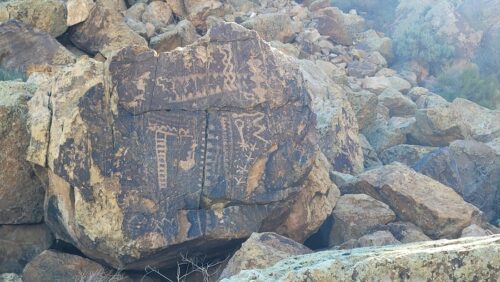
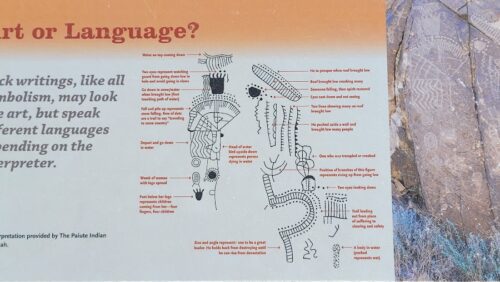
Old news,
stories in stone,
ancient peoples left word
for weary travelers
coming from behind:
The roof caved in, killed many.
He pushed aside a wall,
brought many people low
out from place of suffering
to safety. We will make a place
for you.
Leaving a Mark
It’s human nature to want to leave a permanent mark, to say, “I was here.” This poem was inspired by my wondering why we revere ancient “graffiti,” like the stories written in petroglyphs in the Parawon Gap, but prohibit and punish leaving such a mark on a boulder or cliff, today. We build disposable buildings and fill ugly holes in the earth with our waste, but try etching your name and a date into a cliff and see how fast you wind up paying a hefty fine or spending time in jail.
Marks left by ancient ancestors
rest protected, precious - yet we erase ourselves, leave no trace,
dare not deface a humble rock,
a wall, a tree with even the tiniest proof that we
were here.
Dinosaur Tracks Recreation Area
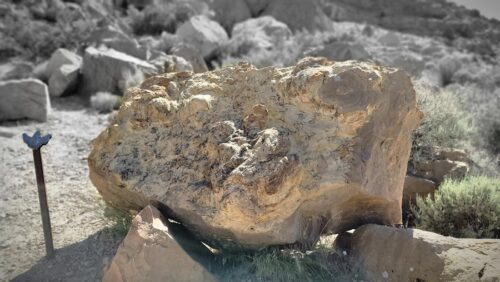
Just a rockfall
from the petroglyphs
find layered rocks for climbing
here, imagine tracks of
dinosaurs - a Rorshach blot
of footprints frozen
in time.
Cedar Breaks
Jackie’s son got the mail and mistook this one for a suicide note. It was anything but – it was my longing to go where none but the ravens could go. You can see the spot, here in this photo – a high, rock-walled rectangle that contains a few trees.
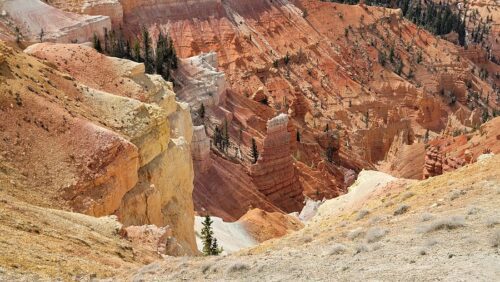
I point far below. Tell him
this is where I live now. High
rock walls surround
a sunlit patch of sandy ground
tall pines, red rocks, colorful
layers of a hundred million years.
Raven laughs overhead. Thinks
no, this is where you die.
Alone. Silence broken by wind.
Strong winds, beating wings.
If I could get there, I add. Raven
laughs again. Good luck
getting out again. And there it is:
In my next life, let me be a raven.
Anniversary Getaway
When you’ve seen mountains like these, it spoils you for smaller ones.
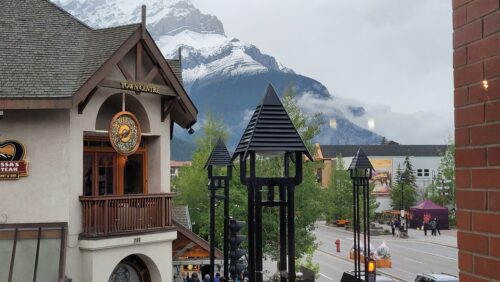
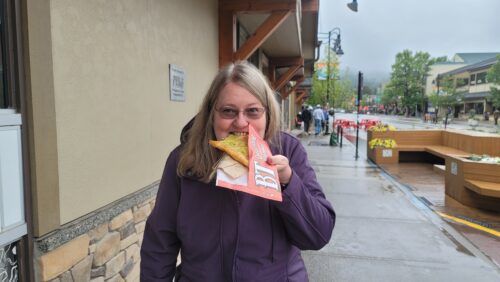
We spent our anniversary in Calgary and Banff. Got some tail while we were at it—beavertail, that is. Wait, that doesn’t sound any better, does it? Here I am, unrepentant:
Hiking in Belgium
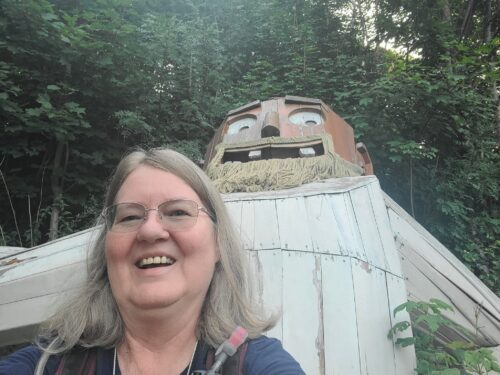
While we were in Belgium, I hiked in the Flemish Ardennes, where I found giants.
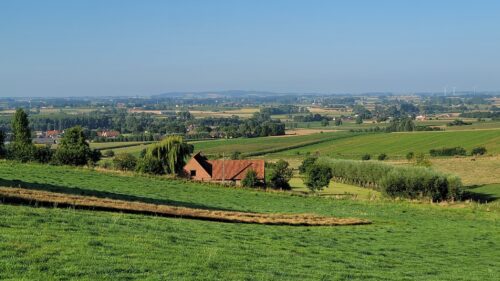
We visited Brussels, Antwerp, Ypres, Ghent, and Bruges. We definitely got our steps in! On the drive from Kluisbergen, a pleasant little town where we stayed most of the time, to Ypres, a comment by my husband made me a little sad. Although I love all the convenience of living in the suburbs of a big city, I prefer the woods and streams to the impermanent, often soulless, things put there for human convenience. I jotted this poem on my phone while he, no doubt, assumed I was doomscrolling on Facebook.
On the A19 to Ypres
Nice bridge, he says,
and there it is - the gap
in how we see the world.
I think the bridge a blight
that spans a river,
joining land to land,
to staunch its flow -
an ugly, man-made stitch
to bind the earth,
to slow the chasm
river-wrought, so they
can stride and straddle it
believing they are giants.
A sobering visit to the In Flanders Fields Museum in Ypres inspired me to read more poetry from WWI. Most of us know the poem, “In Flanders Fields” by John McCrae:
In Flanders fields the poppies blow
Between the crosses, row on row,
     That mark our place; and in the sky
     The larks, still bravely singing, fly
Scarce heard amid the guns below.

We are the Dead. Short days ago
We lived, felt dawn, saw sunset glow,
     Loved and were loved, and now we lie,
          In Flanders fields.

Take up our quarrel with the foe:
To you from failing hands we throw
     The torch; be yours to hold it high.
     If ye break faith with us who die
We shall not sleep, though poppies grow
          In Flanders fields.
I read this poem now in a different tone—less heroic and more naively warmongering. I have now seen what trench warfare really looked like: terrifying, claustrophobic, muddy, bloody. No one could come out unscathed. You who haven’t fought in war think you have “PTSD”? You have issues, but they can never compare to what used to be called “shell shock.” I think the poet Siegfried Sassoon captured it well and without fanfare in “Memorial Tablet (GREAT WAR)“:
SQUIRE nagged and bullied till I went to fight,
(Under Lord Derby’s Scheme). I died in hell—
(They called it Passchendaele). My wound was slight,
And I was hobbling back; and then a shell
Burst slick upon the duck-boards: so I fell
Into the bottomless mud, and lost the light.

At sermon-time, while Squire is in his pew,
He gives my gilded name a thoughtful stare:
For, though low down upon the list, I’m there;
‘In proud and glorious memory’ … that’s my due.
Two bleeding years I fought in France, for Squire:
I suffered anguish that he’s never guessed.

Once I came home on leave: and then went west…
What greater glory could a man desire?
This line appears on a wall in the museum, not far from McRae’s more well-known poem:
I died in hell—
(They called it Passchendaele)
Watch the movie 1917 a few times and you might begin to get a sense of the horror, but just the merest, safest, comfiest sense of it. I would like very much never to have occasion to write a first-hand war poem, though WWI seems to have inspired quite a lot of poetry in those who experienced it. I spoke with someone online, for a while, who claimed to be a soldier in Ukraine. I think most of the messages were written by AI and I’m about 98% sure it was a scammer, but that doesn’t invalidate one of the points they made – that poetry doesn’t have to be angry or activist, doesn’t have to call out injustice and what we’re fighting against. It is, perhaps, just as important—maybe moreso—for poetry to remind us what’s worth fighting for.
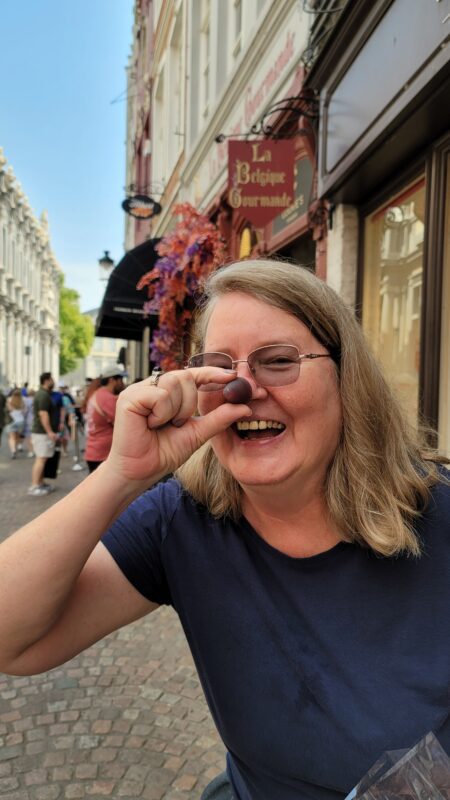
My husband and I spent a few days in Amsterdam, enjoying freshly-made Stroopwafels, chocolates, cheeses, excellent food, and windmills.
Pittsburgh?? Why Would You – OK, on Two Conditions
My husband has always wanted to go to Pittsburgh. Don’t laugh; it’s actually a lot nicer than I remembered it. Still, it’s…Pittsburgh! So for years, I balked. Finally, I relented, on two conditions: First, that we take a train around Horseshoe Curve, and second, that we stop in Hershey for chocolate and for me to make a Reese’s Peanut Butter Cup as big as my head. Bonus: I got to meet my cousin Amy for the first time. Second bonus: We spent a couple of days in Philadelphia. It’s not hard to talk me into visiting any place that has history.
My Husband Takes Me to the Best Volcanoes
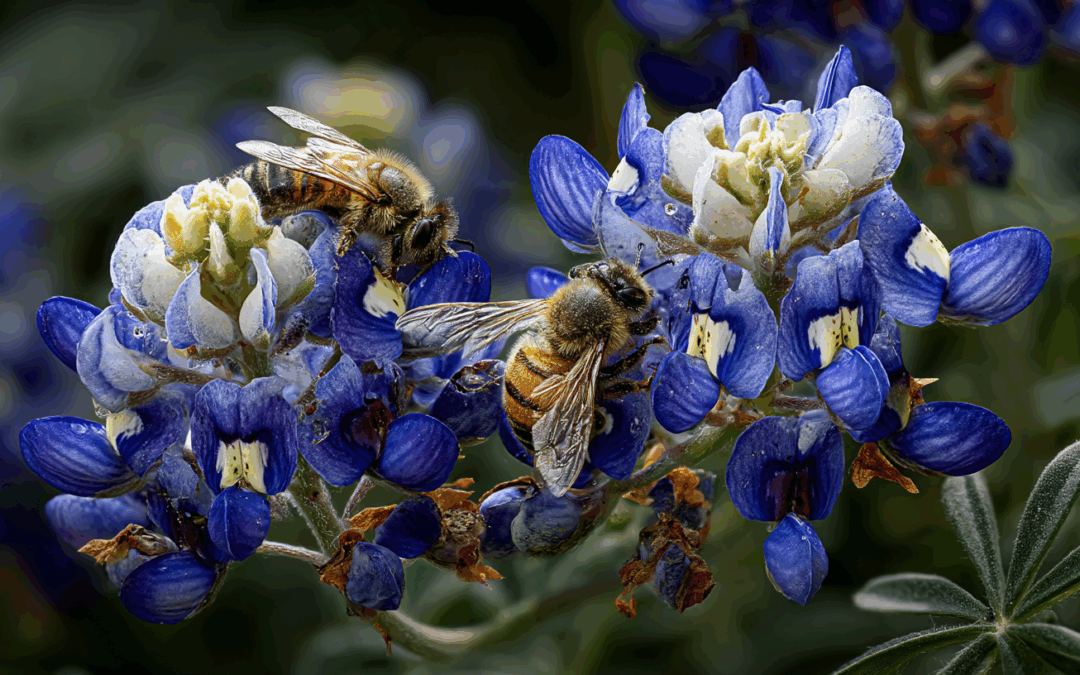
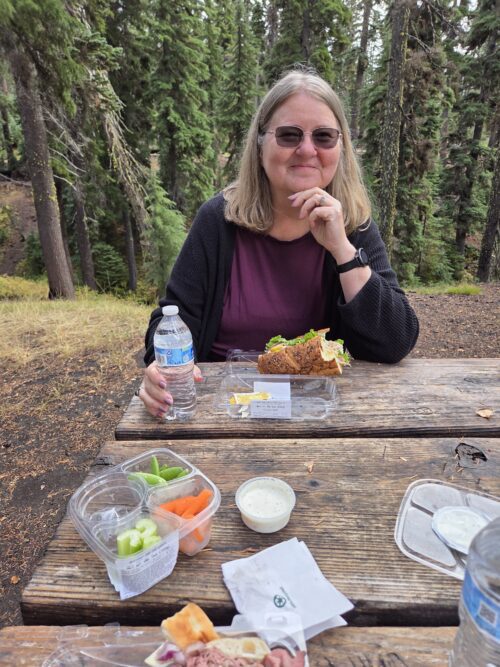
When we got to Portland, it was afternoon and we had a long drive to make it to Crater Lake before dark. We made it, but it was cold, rainy, and foggy. We only got the tiniest hint of the breathtaking beauty that was to come. The next day was partly cloudy, with stunning moments of sunshine that let us see the whole of Crater Lake. We found a little secluded picnic area and enjoyed the sandwiches we’d bought that morning. Until a pesky bee started bothering us. I shooed it off. It returned, moments later, with a friend. The friend brought more friends. We took that as a sign that it was time to move on.
We stayed in Bend, OR. If I lived in Bend, I would go to the river and learn to surf. The gardens, trails, and parks are gorgeous. After exploring a few and getting our steps in, we enjoyed good food and rest. The last day, we hiked the lava fields before returning to Portland to visit family.
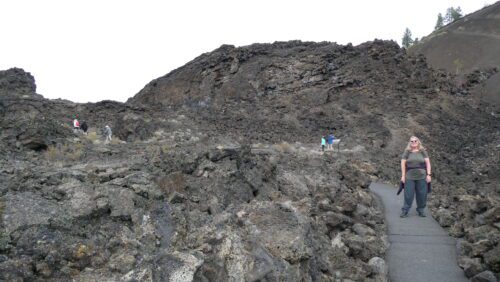
By now, friends are playing the “Where’s Holly?” version of “Where’s Waldo?” or “Where in the World is Carmen San Diego?”
Relaxing in the Dominican Republic
Would you travel to an island while a hurricane meandered off the coast, undecided as to where and when to turn? We had the Westin Puntacana almost to ourselves. The weather was perfect and perfectly tropical—warm, breezy, and sunny in the mornings with windy rain and thunderstorms in the afternoon that cleared in time for dinner and did not resume until we were safely ensconced in our room for the night.
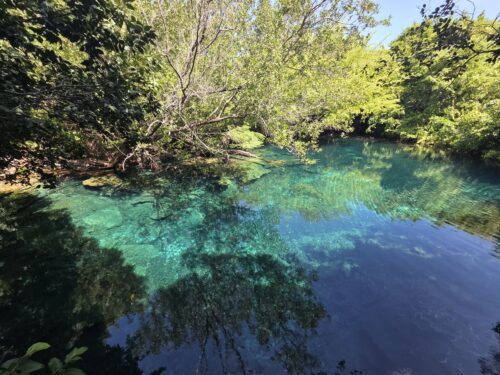
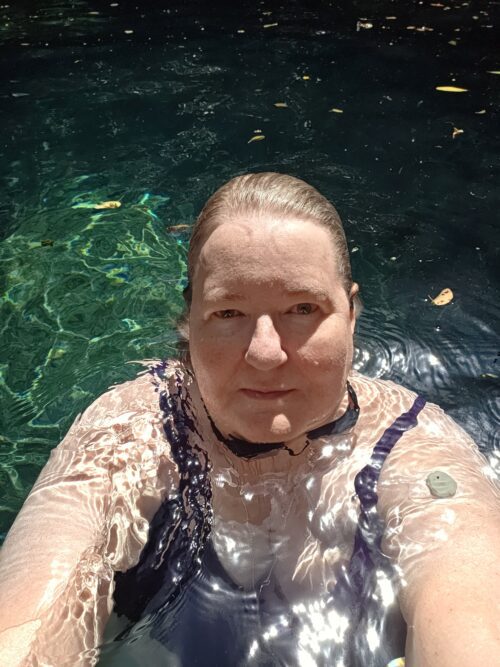
The hurricane did not make its devastating turn until we were back home, and spared the easternmost side of the Dominican Republic, where we were, most of its destruction.
Melissa Comes to the Islands
Sunshowers and summer
lassitude, language languishing,
lazy. Heat-sapped mind-drift,
sargasso thoughts floating limp,
languishing with humidity. Brain bobbing
gently bouyed on throbbing waves
from distant storm-swept seas,
sandy shores. Palm-frond fingers frolic
on a breeze, click frantic warnings
as wind—dawn's waking whisper—
roars in with thunder, slides down
dark mountains, bearing an ocean sizzling
electric with lightning, lashing rain.
So I’m back, now. No big trips planned for the remainder of the year. The next little trip will be a weekend in Dallas for Poets in a Pumpkin Patch, the Poetry Society of Texas Annual Awards Banquet (luncheon, no ballgowns or tuxes required!). I’m told I’ve won a First Place prize in one or more of the 100 categories of the annual contest, which is exciting – it’ll be a first, and means those poems will be published in our annual anthology, A Book of the Year.
Speaking of Anthologies…
The latest anthology of short stories from the award-winning Pen & Keyboard Writers is now available for purchase from Amazon or Barnes & Noble online:
- Literary Graffiti: Then I Grew Up: Adamsons, B S, Akins, Carpenter, John: 9798232706500: Amazon.com: Books
- Literary Graffiti: Then I Grew Up by B S Adamsons, Akins, John Carpenter, Paperback | Barnes & Noble®
This year’s anthology features short stories from fourteen authors, all members of the Pen & Keyboard Writers, an affiliate of the Oklahoma Writers Federation Inc (OWFI).
Till next time!
H.