by Holly Jahangiri | Apr 6, 2026
Day 5½: National Poetry Month
Earlier, I skipped Sunday’s “being so grumpy you hate everything,” prompt. But by 9:15 PM, I was channeling my inner to Darwin. “I hate myself, I hate clover, and I hate bees.”
That’s not the foundation of good poetry. I was reminded, last year, that one of the functions of poetry is to remind people what it is they’re fighting for, not just venting, protesting, or serving as the rallying cry for what they’re fighting against. I don’t want the poems I leave behind in the world to exude negativity.
But there is something relatably humorous in Charles Darwin’s occasional loathing of everything – he was clearly a man who loved everything enough to study it meticulously. The term “love-hate” didn’t enter the lexicon during Darwin’s lifetime, but it would seem to capture his feelings perfectly. He must have been tired and terribly frustrated when he wrote that.
Easter is an important holiday for Christians. But there was so much hypocrisy online, yesterday, that it was hard to appreciate the intended message. From Good Friday to Easter, I cannot help but think how lucky humanity is that I’m not God. Imagine “giving your only begotten son” as a sacrifice to wipe clean humanity’s sin, only to have them go forth and sin again and again and again – cheating, destroying, murdering, wasting, hoarding, depriving their fellow humans of life, liberty, and happiness – without remorse or contrition? I would not be so forgiving, but then again, I’m a mother – it took me nine months to birth a human and I didn’t do it for them to be killed or to kill another mother’s children. An omnipotent God could simply crush the planet and remake it in a week. Food for thought…
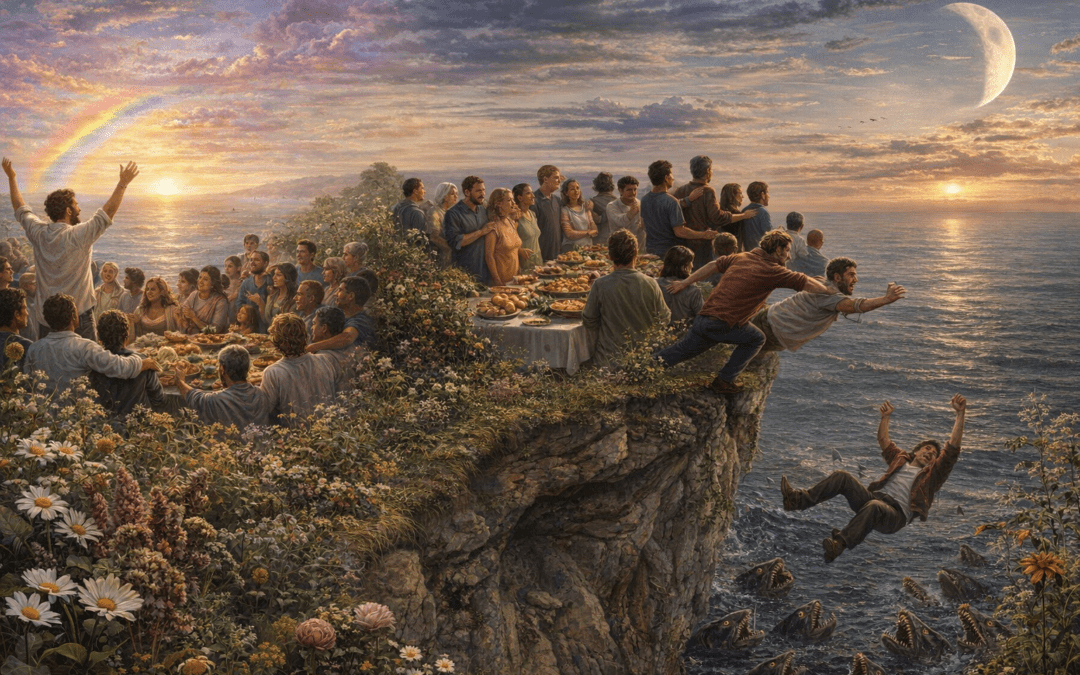
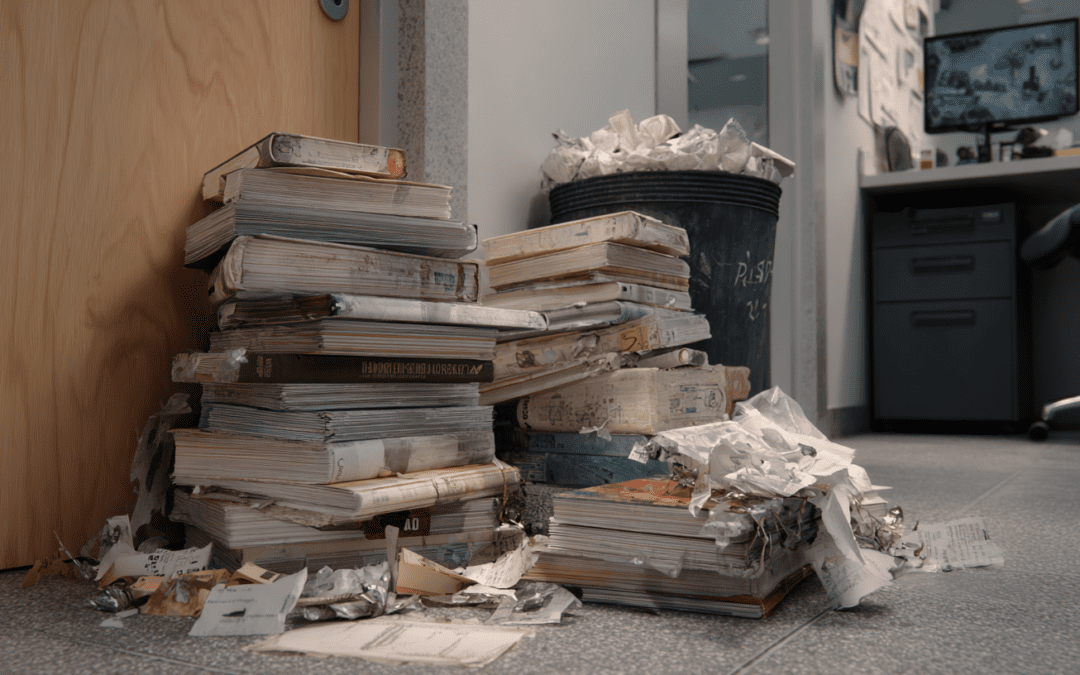
Embrace Mankind, or Shove ’em Off a Cliff?
In the morning, I would lift my voice
and call mankind to sing the sunrise —
weave it into rainbows, cotton-candy
clouds that stretch from shore to shore
and weep as they embrace us all.
By noon, I would lay a feast, inviting all
to rest and eat their fill – break bread
together, singing, “Kum ba yah”
communing with our maker. There is enough —
no need to stuff our pockets full for later.
By evening, I would say, “Look! There
sets the moon a silver streak, shimmering —”
They would lean in, pause their squabbling
for a moment… It would be so easy.
Waste not, want not. Amen.
Voracious fish are waiting patiently below;
with faith that there’s enough to go around.
Other National Poetry Month Posts
Your Turn!
What makes you grumpy? Have you ever tried writing it out in poem form? For me, it’s usually some form of dishonesty or hypocrisy.
Thank you for visiting and reading. I hope you’ll leave a comment – maybe even a poem – below.
by Holly Jahangiri | Apr 5, 2026
Day 5: National Poetry Month
Today’s prompts: “energized,” “safety,” and “being so grumpy you hate everything,” like Charles Darwin hated clover and bees. It is also, conveniently, “E” – happy Easter to those celebrating it. I hope you woke to a beautiful sunrise!
Energized
black sand soil sizzles —
ice-sparkle starlight
on alien hills, craters
dress for the Arctic —
first light will dazzle,
kiss away frost breath
Haleakalā
dawn calls forth purple
silverswords.
ZipOdes
Returning, for just a moment, to my personal “forms challenge.”
Thanks to the poet Jane Honchell, whom I met through The Stafford Challenge, I learned about a poetry form called ZipOdes, invented in 2015 by O, Miami Poetry Festival, and WLRN.
What a great way to celebrate the state in which we live!
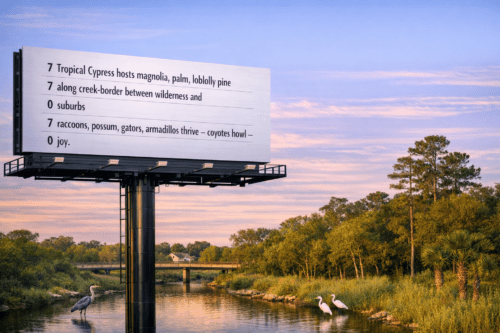
First, write out your ZIP code, vertically, down the left side of the page. Each number is the number of words per line – write each line to the right of the numbers. If you have a zero in your zip code, that line is a wild card! You can leave it blank, insert an emoji or symbol, or use any number of words between 1 and 9. If you are coming to this post from a place that uses alphanumeric postal codes, Kris Archie came up with a solution: When the line has a letter instead of a number, that line has one word that must begin with that letter.
An example using zip code 77070:
7 Tropical Cypress hosts magnolia, palm, loblolly pine
7 along creek-border between wilderness and
0 suburbs
7 raccoons, possum, gators, armadillos thrive – coyotes howl –
0 joy.
Give it a try! Post yours – or a link to yours – below.
Other National Poetry Month Posts
I’m going to have to think a bit on the “grumpy” poem. I’m sure one will come to me before the day is out. Darwin is such an inspiration – I have had days like that, and even posted something about hating clover and bees on Facebook, recently. Why, my Day 2 poem might even fit the bill! Go read that and say I merely jumped the gun…
Your Turn!
What makes you grumpy? Have you ever tried writing it out in poem form?
What are you doing, if anything, to celebrate Easter?
Thank you for visiting and reading. I hope you’ll leave a comment – maybe even a poem – below.
by Holly Jahangiri | Apr 4, 2026
Day 4: National Poetry Month
Today’s prompts from Na/GloPoWriMo and Writers Digest PAD were “weather” and “friends.” And while friends may not be obviously incorporated here, the idea led to me to thoughts of how “traditional friends and allies” can turn, unexpectedly – and how “traditional enemies” may be unintentionally emulated through seemingly casual, ordinary actions and interactions. And even while the world burns, the most ordinary things in life go on. I used that dissonance as a springboard, and the storm as both a real thing and a metaphor. Interpret through your own lens.
Storm Front
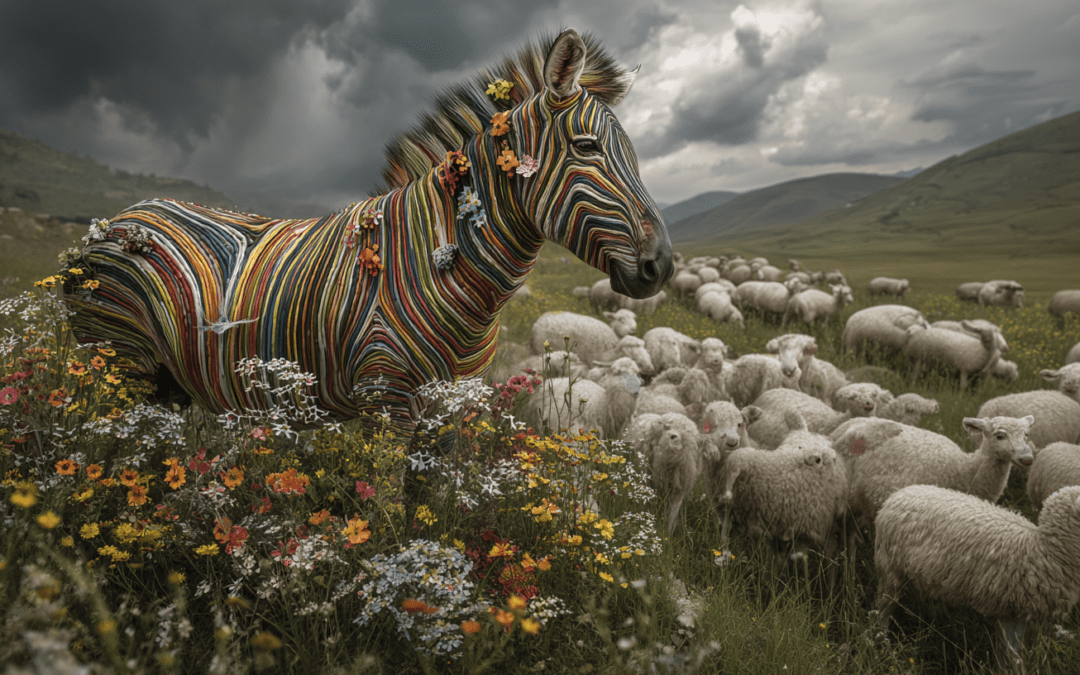
Stagnant storm clouds glower
to the west. You note the creeping dark
but gather up your errand notes,
your shopping lists, and run them.
Friends mutter, “Interesting
weather.” Give them a safe nod.
“Rains coming.” The whole exchange
feels like B-movie spy code.
It’s old and everything’s a war
run by crime boss caricatures. War
on drugs, war on books, war on women, war
on war – we have a thousand tsars.
Ghost-carts sail on asphalt
wage an ordinary war, bent-out-of-shape
they menace with wall-eyed wheels; you
do battle for a parking space.
You race the grumbling thunder-rain
and its inevitable oncoming,
each transformer-explosion flash
electric – adrenal gland on drums –
Thrums, energized, through veins
a streak not blue enough, zings
a shockwave nerve assault. You
barely make the light that takes you home.
I drafted a first poem, this morning, on Facebook – just idle musings, really (no one said a poem a day had to be 365 good poems) but since I’m lately in the habit of deleting old Facebook posts because they’re no longer timely and relevant, I’m going to share it here.
Divide and Conquer
What would divide us –
keep us weak – if not
religion, borders,
skin, or gender?
Not selfishness
so much as greed,
a need, a craving
to compete. For some
the race to space
was aspirational –
fulfillment of recurring
dreams of curiosity –
while others merely play
at “King of the Hill”
and race to plant a flag,
to stake a claim,
to subjugate the cosmos,
bend it to their will,
and leave it poorer.
Other National Poetry Month Posts
Your Turn!
Do you think most humans naturally enjoy being divided and having someone to compete with? If so, why not engage in competitions that could benefit humanity as a whole? Surely even a large financial prize for the “first” or “best” solution would be less costly than a destructive war and far less cynical.
Would you rather eat at a chain restaurant, where you could safely predict whether you’d like the food – even if you didn’t love it or weren’t excited by it – or at a new restaurant serving foreign (to you, wherever you are in the word) cuisine? How about when you’re traveling to another state or country? Don’t mind me – I’m still depressed by the Burger King in Istanbul and the Popeye’s Chicken at the Ataturk Airport. This morning, I read that there are only 11 authentic, locally-owned Hawaiian restaurants that are not chains. (I didn’t read the whole article and it may or may not be accurate. I hope it was limited to Oahu, which is not “all of the state of Hawaii.” But I will say Maui has become a generic, if pricey, haole haven. <yawn> Not the Hawaii I remember from the 1970s, for sure.)
Any other thoughts? The mic’s all yours (just be kind, be real – the castle goats eat trolls when they gather under the bridge to drink from the moat, and the resident bard freely steals from the spammers to mock them with ribald songs and poetry – so you’ve been warned! Or welcomed. Your choice.)
by Holly Jahangiri | Apr 4, 2026
Day 4: National Poetry Month
See Apricots: a Tanka Encompassing Three Prompts for the prompts I’ll be using (if I use any at all) this month. To the extent possible, I’m determined to combine all three, plus the Blogging A to Z Challenge, each day. That said, I reserve the right not to – despite my conviction that creativity thrives when challenged to overcome constraints.
I recommend reading the daily posts at each of these sites to get a fuller picture of the prompts, though I will summarize them here so you get the general idea:
Be sure to check out some of the Blogging A to Z blogs here, too! And do leave comments – seriously, don’t be shy. Real people who still blog still love to get comments! Egg ’em on! I’m number 81 of 133 on the list, this year.
Looking for more prompts? How about these Poetry Prompts: 100+ Ideas to Inspire Your Next Poem?
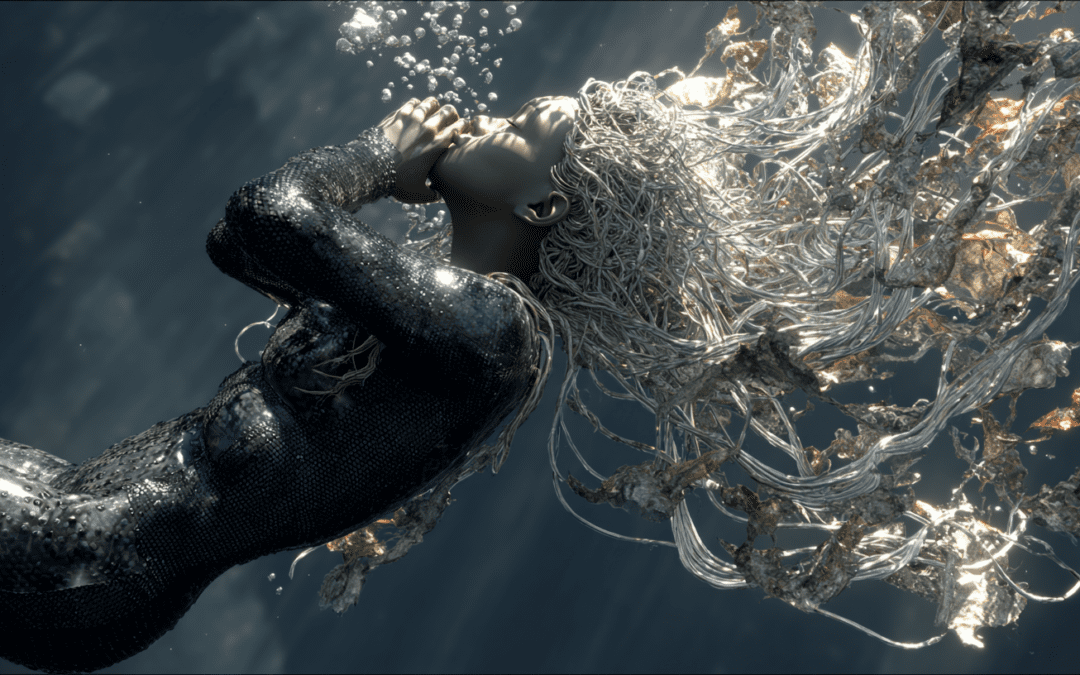
Dive
Can you teach a fish to SCUBA dive?
To wear a weighted belt of rocks
tied tight with kelp, and rubber shoes
to cover fins? Can you teach a whale
not to leap for shimmering joy,
breaking surface tension,
making waves, to splash
her sons and daughters –
would you say
it wasn’t “seemly” to be seen
to play, to ride the Gulf Stream
drafting in the wake of ocean liners?
Can you wear your sleek
skinsuit, drink moonlight, dive
and savor saltwater, fresh
and frigid, bioluminescent,
wearing nothing but the weight
of your own thoughts,
tangled in your seaweed hair,
toes’ unfettered fluttering
sending you down, down, down
into a dark, watery embrace?
Inspiration
I’ve tried SCUBA diving. I’m bad at it. I love snorkeling, though. Last time, I even (grudgingly) accepted the requirement and rationale of wearing flippers. Once I got used to them, I really could swim faster and easier with them than without. But that weight belt? I sink like a rock or pop up like a rocket. I cannot maintain equilibrium, so I won’t SCUBA dive lest I take out a coral reef single footedly. Unfortunately, that means I’ll never get to fully explore this amazing, indoor pool: Deep Dive Dubai: Scuba Diving, Freediving, & Snorkelling
Other National Poetry Month Posts
Your Turn!
Do you like to dive? Diving board, free dive, snorkeling, SCUBA?
Have you ever gone swimming with dolphins or whales?
As always, I love to get your comments on this blog, provided you’re a kind human and not a spambot or troll!
by Holly Jahangiri | Apr 3, 2026
A “bonus post” since I jumped the gun before some of the prompts were posted! So here’s the second challenge, to combine the following:
“Open _____ ” and “a poem in which a profession or vocation is described differently than it typically is considered to be.”
Technically, a Writer
Open chat.
Enjoy the cameraderie of writers.
Until the conversation turns
to royalties and contracts,
publishers and agents…
“Have you been published lately?”
They ask, to be polite.
Consider yanking the modem cord from the wall.
“Line noise.” (Lame excuse.)
Then realize that it’s really all
a matter of perspective. Tell them
“Yes,” of course. Tell them
that your last book (you’ve lost count)
was published (because it was)
in more languages than those
of the famous author they adore —
twenty-six, you think. Maybe twenty-eight.
Five million books sold, worldwide.
(So far.) But who’s counting.
Fifteen hundred, two thousand dollars
each, and readers seem happy —
you get paid, right as rain,
every two weeks. You’d tell them
how much, but they’re already green
with envy. “Best part of the deal?”
you say, “Each reader gets a free PC
with every book.”
It’s all a matter of perspective.
Mine.
Inspiration
Another true story. When I was in college, studying Rhetoric & Writing, I dreamed of writing novels for a living. Or getting paid to write – I’d settle for that. After a few years in computer operations and systems engineering, during which I suffered from a massive case of “imposter syndrome,” I was tapped for a job as a technical writer. I didn’t know what that was, but it had the word “writer” in it and it wasn’t a demotion. I write well, I’m technically adept, curious, and a quick learner. I retired, in 2020, after almost 30 years of documenting hardware and software. Much of it was behind-the-scenes work, creating unglamorous but auditor-required internal systems documentation in fields like oil & gas and airline industries, until I went to work for Compaq/HP and wrote User Guides, online Windows Help, and eventually returned to a more technical field – data science, mining tens of thousands of product reviews for customer experience insights.
I have also published children’s books, anthologies of short stories and poetry, non-fiction articles, and blogs. Now, I am President and Webmaster of the Poetry Society of Texas and most of my writing is focused on poetry. But really, when someone asks me, “What do you write?” it’s easier to say what I don’t write. I don’t write about finance. Math was never my favorite subject.
This poem was an actual conversation I had in the Writers’ Ink RoundTable on GEnie in the 1990s — back when we still had modems that plugged into the wall. Probably at 14,400 baud. My books never bore my name, but that’s a blessing in disguise – I still got paid, “right as rain, every two weeks!” and didn’t have to field support questions. Ironically, a good chunk of my time, now, is spent fielding support questions from writers. About Windows and Word, self-publishing platforms, book covers, websites and blogs, copyright issues…
And lets not forget “how to answer a call on my Samsung Galaxy phone.” I’m hoping that, for once, you’re here for the poetry.
About the Prompts & Challenge for April
See Apricots: a Tanka Encompassing Three Prompts for the prompts I’ll be using (if I use any at all) this month. To the extent possible, I’m determined to combine all three, plus the Blogging A to Z Challenge, each day. That said, I reserve the right not to – despite my conviction that creativity thrives when challenged to overcome constraints.
I recommend reading the daily posts at each of these sites to get a fuller picture of the prompts, though I will summarize them here so you get the general idea:
Be sure to check out some of the Blogging A to Z blogs here, too! And do leave comments – seriously, don’t be shy. Real people who still blog still love to get comments! Egg ’em on! I’m number 81 of 133 on the list, this year.
Other National Poetry Month Posts
Your Turn!
How might you look at your current job from a different perspective?
As always, I appreciate your comments – please leave one before you leave! And come back for more conversation. You can subscribe to get new posts and follow-up comments. If you subscribe to my Substack, you’ll occasionally get a little digest of new posts and random observations. No spam from me, and no cost to subscribe, I promise!