
Day 24: National Poetry Month
X is an interesting challenge, isn’t it? It isn’t really a poet’s friend, at least not in English. I can’t think of X without thinking of the Echthroi in Madeleine L’Engle’s books A Wrinkle in Time; A Wind in the Door; and, A Swiftly Tilting Planet. The Echthroi were the antithesis of good, corrupting or unnaming and unmaking what they couldn’t corrupt. Antimatter. Antispirit. Anti-everything.
X seemed an appropriate name for the site formerly known as Twitter, to those of us who’d read L’Engle. People who haven’t will not understand why we worry, you know, about…Space. In L’Engle’s work, X is a visual symbol for unnaming and annihilation.
But of course, L’Engle got the word from classical Greek—from Aristotle’s analysis of tragedy, where echthros, philos, and medeteros equate to antagonist, protagonist, and neutral character to the New Testament, where Jesus commands his followers to “love their enemies.” The word for enemies is “echthroi.”
Echthroi
Across the universe, expanding, characters
demanding understanding of their foibles,
flaws, and peccadillos—”Love me, love me
take me as I am, as Christ commands”—
Their river only flows one way. There is no dam
to save us from a decade’s drought,
no drought to dry the hot, indifferent tears—
not grief, not loathing tearing down
the gates of Hell, but apathetic nothingness:
true emptiness, the opposite of love.
To satisfy the Blogging A to Z Challenge without cheating, I’m going to give you a different sort of tidbit in this post: I’m going to explain how to create an index in Microsoft Word.
X is for XE (Index Entry)
Creating an Index in Microsoft Word:
- Open a document containing text you’d like to index.
- Highlight a word to include in the index.
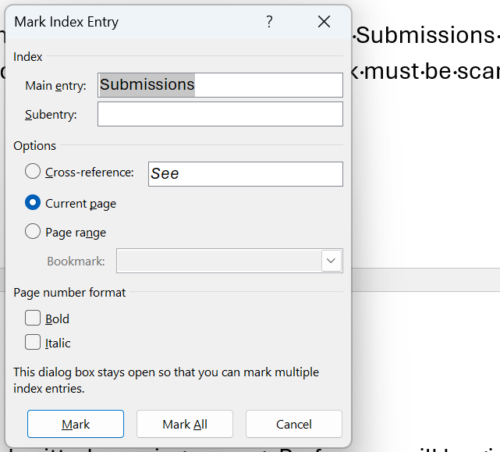
- Click References on the menu at the top of the screen, then click Mark entry.


- Click Mark. This creates an Index Entry (the field is called { XE } in Microsoft Word – which is why I’m showing you this for “X”! Now you know.) In this example, it creates a hidden text field that looks like { XE “Submissions” }. TIP: In order to see hidden fields while you work, click Home on the top menu then click the button that looks like a paragraph marker ¶.
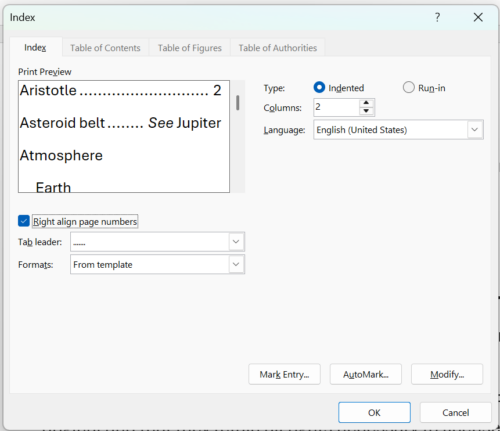
- When you are finished marking index entries, move your cursor to the location in your document where you want to place the index, then from the menu at the top of the screen, click References, then click Insert Index (to the right of Mark entry). Choose your formatting options, then click OK:
I suggest playing with this in a copy of any document you want to index so that you can play around with various options before indexing a whole book.
Creating Multiple Indices in One Document
Here are a few useful tips for poets who want to create multiple indices; for example, let’s say you want to create an anthology arranged by topic, but you want an index of poems by author:
- Turn on hidden text: click Home on the top menu then click the button that looks like a paragraph marker ¶.
- Create an index entry field on each poem that has the author’s name as the Entry and the poem name as the Subentry. Edit the XE field to add \f “authors” between the final quotation mark and the space before the closing bracket }.
- Create an index. Edit the index field to include \f “authors” between the final quotation mark and the space before the closing bracket }.
“authors” can be any name you want to apply, so long as the \f “name” in your index entries match the \f “name” in the index.
Other National Poetry Month Posts
- National Poetry Month, Texas Style!
- Apricots: a Tanka Encompassing Three Prompts
- Bee Sting: Day 2 of National Poetry Month
- Cacophony and CBD: Day 3 in Nonsense Verse and Found Poetry
- Technically, a Writer: Day 3 of National Poetry Month
- Dive: Day 4 of National Poetry Month
- Storm Front: Day 4 of National Poetry Month
- Energized: Day 5 of National Poetry Month
- Grump: Day 5 ½ of National Poetry Month
- Future Frittered Away: Day 6 of National Poetry Month
- Hell, Hell, Hell: Day 7 (More or Less) of National Poetry Month
- Insomnia: Day 8 of National Poetry Month
- Juxtaposition: Day 9 of National Poetry Month
- Knife Edge: Day 10 of National Poetry Month
- Lost a Day: Day 11 of National Poetry Month
- Many Definitions: Day 12 of National Poetry Month
- New Form – Quadrille Quaiku: Day 13 of National Poetry Month
- Ode to Imagination: Day 14 of National Poetry Month
- Pixellated People: Day 15 of National Poetry Month
- Quintessential, Querulous Quintet: Day 16/17 of National Poetry Month
- Renewal: Day 18 of National Poetry Month
- Secrets of the Terrarium: Day 19 of National Poetry Month
- Tenacious: Day 20 of National Poetry Month
- Unruly: Day 21 of National Poetry Month
- Villainous Villanelle: Day 22 of National Poetry Month
- Waiting for the Chimes: Day 23 of National Poetry Month
- X: Day 24 of National Poetry Month
- You Are Here: Day 25 of National Poetry Month
- Z to A, a Reverse Abecedarian: Day 26 of National Poetry Month
Your Turn!
What are your favorite “X” words – or “ex” words?
They say that hate isn’t the opposite of love—indifference is. Do you agree?

I bundle love with Action instead of Emotion. If you are treating opposites as things upon the same scale – hate vs love; hitting vs hugs. Then hate and love are opposites, but If you are measuring extremities within a scale – where hate and love are both measured at 10, then apathy and indifference on the emotional/feeling scale of 0 would be the opposite. In my case, Love as Action and adding in extremities within the scale, the opposite of love would be an inaction – not helping, not hugging, not being there – and not because you can’t or you tried and failed, but because “whatever” and “not my problem”. When at least a little action is easy, opening a door for someone carrying stuff behind you, cleaning a neighbor’s curb while they are sick while you clean your own, not acting with love can measure monsters.
On one hand, hate and love are both strong emotions with an object. Indifference may have its object, but it is an absence of thought or feeling. To love and to hate require that you give that object some of your precious time and energy. They may be opposites but they share the same spectrum. Indifference stands off to one side, oblivious. Love can turn to hate and vice versa; I’m not sure true indifference ever makes the leap onto the spectrum, let alone turns to love OR hate.
I do agree with you that love is action. One can hate without acting on it, but hate withholds anything that might be mistaken for love. Thinking about what you wrote, though – would the mere act of being kind enough to hold a door be “love”? I’m not sure. I hold the door for strangers I neither love nor hate, but I’m not entirely indifferent, either. I would say “thoughtful,” even “kind.” Charging through the door and not looking back to see if it might slam in someone’s face – not intentionally slamming it in a specific someone’s face, just being oblivious to other humans who might be close – that looks more like “hate” but I’d have called it “indifference.” Hmm.
Exceptionally well-written.
Yes, I would agree that indifference is the opposite of love.
“Success is being able to complete what we set out to do – each individual action, each specific step, each desired experience whether a big project or a very small errand.” — Susan Collins
J (he/him 👨🏽 or 🧑🏽 they/them) @JLenniDorner ~ Speculative Fiction & Reference Author and Co-host of the April Blogging #AtoZChallenge international blog hop
Thank you! ❤️